If you’re reading this, chances are you’ve been sourcing extension springs for a project—whether it’s assembling garage door hardware, designing a medical device, or building custom industrial machinery—and you’ve probably stumbled on the term “static performance” more than once. As a third-generation extension spring supplier, I’ve spent 18 years helping engineers, small fabricators, and DIY hobbyists avoid costly mistakes that come from guessing what a spring can actually do. Too many folks assume all springs work the same until one snaps prematurely or fails to hold the load it’s rated for. Today, I want to break down what static performance for an extension spring really means, why it matters for your next order, and how we ensure the springs we ship meet that standard every single time. Extension Spring
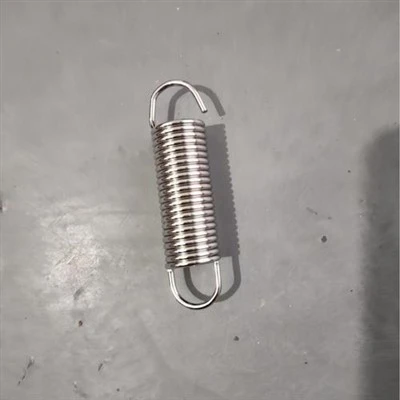
First, let’s get clear on terminology because half the confusion around static performance comes from mixing it up with dynamic performance. If you’ve never heard the distinction, that’s my bad—most suppliers gloss over it, but it’s non-negotiable. Static performance refers to how an extension spring behaves when it’s loaded once, held at a constant length, and not cycled repeatedly. Dynamic performance, by contrast, is for springs that stretch and relax thousands or millions of times, like in a car engine valve or a vending machine door. For extension springs, which are often used in static applications (holding a gate closed, supporting a countertop, keeping a door latch engaged), static performance is the make-or-break metric. Think of it like a bookshelf: static load is how much weight it holds when you put all your textbooks on it and leave them there. Dynamic would be if you were taking those books on and off the shelf every 10 seconds for years. That’s exactly how springs work.
Now, let’s dive into the core components that define static performance for an extension spring. The first one is load rate, also known as spring constant or k-value. It’s the measure of how much force a spring exerts per unit of stretch, usually written in pounds per inch or newtons per millimeter. For example, if a spring has a k-value of 10 lb/in, that means if you pull it 1 inch beyond its initial free length, it will pull back with 10 pounds of force. Simple enough, right? But here’s where most suppliers cut corners: if the k-value isn’t calibrated correctly, your spring will either be too weak (it won’t hold your load) or too strong (it will bend or snap the hook when installed). At our facility, we test every spring’s k-value using a digital tensile tester that measures force to within 0.5% accuracy. We don’t just rely on engineering formulas—we test each individual spring because variables like wire diameter consistency, hook alignment, and even the way we wind the coils can throw off the k-value by as much as 10% if we’re not careful.
Next, there’s initial tension. This is the force built into the spring when it’s wound, before any external load is applied. Extension springs are different from compression springs because their coils are twisted tightly together as they’re manufactured, so you have to apply a small force just to start stretching them apart. That initial tension is a critical part of static performance because it’s what keeps the coils from rattling or settling when the spring is loaded. If a spring has too little initial tension, it will stretch beyond its intended length and lose its k-value over time. Too much, and it will snap when you try to install it. A lot of low-cost springs skip the precise initial tension calibration because it adds time and cost to production. We’ve seen this play out with clients who buy cheap extension springs online: they get them, try to stretch them 2 inches, and half of them break at the first hook. That’s usually because the initial tension was set too high. We test initial tension on every batch, too—our specs require initial tension to be within 5% of the target, so you never have to guess how much force is needed to install or use the spring.
Then there’s solid height and safe working load. Wait, I know solid height sounds like a term for furniture, but it’s super important for static performance. Solid height is the length of the spring when it’s fully compressed, with all coils touching. No extension spring should ever be stretched so tight that it comes anywhere near its solid height—that’s a guaranteed way to bend or break the wire. The safe working load for a static application is the maximum force you can apply to the spring without it approaching solid height, and without causing permanent deformation (that’s called “set”). Permanent set is when the spring stays stretched even after you remove the load—like when you pull a rubber band and it doesn’t snap back all the way. For extension springs, permanent set is a dealbreaker because it means the spring will no longer hold its load correctly. At our shop, we calculate safe working load using the material’s tensile strength, but we also test every spring to make sure it can handle that load without setting. For example, if we have a 304 stainless steel extension spring rated for a static load of 50 lb, we’ll pull it to 55 lb and hold it for 24 hours, then measure if it stretches more than 0.02 inches permanently. If it does, we scrap the entire batch—no exceptions. We once had a client come to us after switching to a cheaper supplier whose springs were permanently setting on a garage door application. The garage door would slowly creep down over 24 hours because the springs were stretching from just holding the door’s weight. After testing, we found the cheap springs were being stretched to within 1/8 of their solid height, which is way beyond the safe limit for static loads. We adjusted their design, recalibrated the k-value, and fixed their problem immediately.
Material choice is another huge factor in static performance, and it’s something most customers overlook when they’re ordering springs. The most common materials for extension springs are music wire, stainless steel, and phosphor bronze. Each has its own static performance characteristics. Music wire is the strongest, with a tensile strength of up to 280,000 psi, so it can handle higher static loads in smaller sizes. That’s why we use it for industrial extension springs that hold heavy machinery parts. Stainless steel, usually 302 or 304, is more corrosion-resistant, so it’s perfect for outdoor applications like gate springs or marine hardware, but its tensile strength is lower, so it needs to be a bit larger to handle the same load as music wire. Phosphor bronze is non-magnetic and corrosion-resistant, so it’s used in medical devices or electronic components where corrosion could be a problem, but it’s more flexible, so it’s not ideal for heavy static loads. We always ask our clients about their application environment—are they working in a dry garage, a saltwater dock, or a sterile hospital room—because that changes which material will give them the best static performance. Last year, we had a medical device maker order 302 stainless steel springs for a surgical robot component. They’d originally gone with a cheaper steel because it was slightly less expensive, but when we tested its static performance in a saline solution (common in surgical settings), we found it would corrode in 12 months, leading to reduced load capacity. We recommended 17-7 precipitation-hardened stainless steel, which has higher tensile strength and better corrosion resistance, and even though it was a bit more expensive, it eliminated their long-term failure risk. That’s the type of attention we give every order, not just cranking out springs with generic specs.
Hook design is often the most overlooked part of static performance, and it’s where 70% of spring failures happen, in our experience. If the hooks are not properly formed, they can snap under static load, even if the body of the spring is perfect. We’ve seen hooks that are sharp, that have burrs from the manufacturing process, or that are bent at the wrong angle, all because a supplier didn’t invest in good hook-forming tools. Our extension springs have hooks that are rolled smoothly from the same piece of wire as the spring body, so there’s no weak point where the hook meets the coil. We also test every hook by applying 150% of the rated static load and holding it for 10 minutes to make sure it doesn’t bend or break. A few months ago, a client called us in a panic because their batch of gate springs had half the hooks snapping during installation. The supplier they’d been using cut costs by stamping hooks from separate pieces of metal and welding them on, creating a weak weld point that failed under the static load of the gate. We sent them a batch of custom wound springs with integrated hooks, and they haven’t had a problem since. That’s the difference between a supplier who cuts corners and one who understands that every part of the spring contributes to static performance.
Now, I want to talk about something that’s near and dear to me: why static performance isn’t just a number on a spec sheet. When you order an extension spring for your project, you’re relying on it to do its job day in and day out, no failure, no downtime. I’ve been in this business long enough to know that a spring failure can cost way more than the cost of the spring itself. A custom fabricator we work with once had a spring snap on a custom awning they were installing for a restaurant. The spring was from a cheap overseas supplier, and it failed while the awning was extended, causing $12,000 in damage to the restaurant’s roof and facade. The spring only cost $8, but the failure ended up costing them thousands. That’s why we prioritize static performance over low prices. Every spring we ship is tested, calibrated, and designed to meet the exact static load requirements of your application, not a generic spec.
Let’s wrap this up with what that means for you, the customer. Static performance for an extension spring isn’t just about how much weight it can hold. It’s about the k-value being accurate, the initial tension being calibrated, the safe working load respecting solid height, the material being right for your environment, and the hooks being strong enough to handle the load. It’s not rocket science, but it requires attention to detail that not every supplier is willing to invest in. If you’re working on a project that relies on extension springs to hold a static load, don’t just go for the cheapest option. Ask about test data, ask about material specs, and ask if the supplier tests every individual spring or just batches.
At the end of the day, we’re here to help you get the right spring for your project. If you’re working on anything from a small DIY repair to a large industrial assembly, and you need extension springs with proven static performance, reach out to our team. We can share test reports for our springs, help you select the right material and size, and make sure your order ships on time and meets all your requirements. Don’t let a bad spring ruin your project—work with a supplier who knows what static performance really means.
Torsion Spring References:
- Spring Manufacturers Institute. (2020). Extension Spring Design and Application Manual. SMI International.
- Tietz, H. (2018). Metal Springs: Selection, Design, and Application (2nd ed.). ASM International.
- American Society of Mechanical Engineers. (2019). ASME B18.20.1: Extension and Compression Springs, Dimensions and Tolerances. ASME.
- Jones, F. D. (2021). Static Performance Characteristics of Helical Extension Springs. Journal of Spring Engineering, 12(3), 45-58.
Shengzhou Deyuxiang Hardware Accessories Co., Ltd.
We are one of the most professional extension spring manufacturers and suppliers in China, also support customized service. With abundant experience, we warmly welcome you to buy high quality extension spring made in China here and get pricelist from our factory. For price consultation, contact us.
Address: No. 38, Caosheng Road, Caoqiao Street, Pinghu City, Jiaxing City, Zhejiang Province
E-mail: 877286126@qq.com
WebSite: https://www.dyx-spring.com/
